Solar Window Screens: How to Choose the Right Type for Your Home
Solar Window Screens: How to Choose the Right Type for Your Home
💡 Quick Answer
Exterior solar window screens are dense-mesh panels mounted outside the window frame that intercept the sun's rays before they ever reach the glass — blocking up to 90–99% of solar heat and UV depending on the openness factor chosen. A 10% openness screen blocks roughly 90% of heat; a 5% screen blocks roughly 95%; a 3% screen roughly 97%. Fiberglass-core fabrics like Mermet's Natte and Satine lines outperform polyester in sustained desert heat, resisting sagging and fading better. In Arizona, west-facing windows need 3% openness fabric; south and east windows typically take 5–10%. Professional installation runs $50–$150 per standard window in 2026. This guide does not cover window film, awnings, or interior solar shades as primary solutions — those appear only where a direct comparison helps you make a better decision.
📊 Key Takeaways
Six facts from this guide that change what you should do next — one per chapter, specific enough to act on.
Not an insect screen
Solar screens use engineered dense mesh to block solar radiation; standard insect screens let 65–70% of light pass straight through and block almost no heat.
Exterior placement wins
Windows drive 25–30% of residential cooling energy use (U.S. DOE); exterior screens stop heat before it hits the glass, which interior blinds and solar shades cannot do.
Match density to direction
West-facing windows in Arizona need 3% openness fabric (roughly 97% UV protection); south and east windows typically take 5–10% — using one density everywhere is a mistake.
Fiberglass outlasts polyester
Mermet fiberglass fabrics (Natte and Satine) resist sagging and carry a 10-year no-fade warranty; polyester-core mesh is more prone to stretching under sustained desert heat.
$50–$150 per window in 2026
Fixed exterior solar screen installation runs $50–$150 per standard window; custom or large openings reach $80–$280; retractable motorized systems are priced per project by opening width.
Night privacy reverses
The daytime one-way privacy effect flips at night when interior lights are on — bedrooms often need a secondary interior shade to maintain nighttime privacy year-round.
If your west-facing living room bakes every afternoon, your cooling bill spikes every summer, and your rugs and flooring have started to fade, the problem has a specific location: your windows. Exterior solar window screens stop the sun's rays before they ever reach the glass — which is a fundamentally different approach from every interior window treatment on the market. This guide explains exactly how solar screens work, why placement outside the frame matters so much, how to match screen density to window orientation across your home, what solar screen material and frame options actually hold up in desert conditions, and what installation costs in 2026. It's written for Tucson and Phoenix homeowners facing real desert heat — not for someone in Seattle deciding between blinds and curtains.
What exterior solar window screens actually do
Exterior solar window screens are dense-mesh panels mounted outside the window frame that intercept the sun's rays before they ever reach the glass, blocking 90–99% of solar heat and UV depending on the fabric openness factor chosen. This guide covers how the screens work, why exterior placement outperforms every interior window treatment at reducing heat, how to match openness factor and screen density to window orientation, what solar screen material and frame options matter in a desert climate, how cost and installation break down in 2026, and what to realistically expect from UV protection and energy savings. It does not treat window film, awnings, or interior solar shades as primary solutions — those appear only where a direct comparison helps you make a better decision.
Chapter 1 · Foundation
What Solar Window Screens Actually Are (and What They're Not)
A solar window screen is not a standard insect screen — it is an engineered solar control product, and confusing the two leads to real disappointment. Standard pop-out insect screens use an open weave that lets 65–70% of light pass straight through; solar screens use a tightly woven, vinyl-coated polyester or fiberglass-core mesh purpose-built to absorb and reflect solar radiation. The difference in materials, density, and function is fundamental. This chapter draws a sharp line between the two products and explains what the mesh is actually doing when sunlight hits it.
Solar screens use a dense mesh — typically vinyl-coated polyester or PVC-coated fiberglass — that is engineered to intercept solar radiation, not just block insects. The weave is far tighter than a standard screen, and the yarn material is chosen for heat stability and UV resistance rather than simply for keeping bugs out. A homeowner who installs a standard insect screen expecting solar performance will get neither.
The defining specification: openness factor
The defining specification of any solar screen is its openness factor: the percentage of the mesh surface that is open space. A 10% openness screen lets 10% of light pass through and blocks roughly 90% of UV and solar heat. A 5% screen blocks roughly 95%, a 3% screen roughly 97%, and a 1% screen up to 99%. Lower openness means more heat blocking but less outward visibility; higher openness preserves the view but reduces heat rejection. Every buying decision for solar window screens starts with this number.
Fabric core material is the second key variable. Fiberglass-core fabrics — like the Mermet Natte and Satine lines used in TRSS Solution Screens — use thinner yarns than polyester-core screens. Thinner yarn means more small openings in the weave, which delivers a cleaner view-through at the same openness rating. Fiberglass is also lighter and more heat-stable, resisting sagging and stretching during the months of sustained direct sun that Tucson and Phoenix screens face every summer. Polyester-core screens cost less upfront but are more prone to deforming under prolonged desert heat.
Solar shades and interior solar blinds use similar mesh fabrics but mount inside the room. They manage glare and reduce some radiant heat, but they cannot stop solar energy outside the building envelope — a critical distinction covered in detail in the next chapter. Interior window treatments are window treatments; exterior solar screens are solar control products. The two categories are not interchangeable, and that distinction should shape every purchasing decision.
Key takeaway
Solar screens use a dense fiberglass or polyester mesh with a defined openness factor (1–10%) that determines how much solar heat and UV they block — a 5% screen blocks roughly 95%, while standard insect screens block almost no heat at all.
Chapter 2 · Mechanics
Why Exterior Placement Beats Interior Window Treatments on Heat
The placement of a solar screen — outside the glass versus inside the room — is the single biggest factor in how much heat it actually stops. Exterior solar screens intercept sunlight before it reaches the glass at all; interior blinds, curtains, and solar shades only manage sunlight after it has already passed through the glass and become heat inside the room. That is not a minor difference. The U.S. Department of Energy attributes 25–30% of residential heating and cooling energy use to heat gain and loss through windows, which makes windows the highest-value target for reducing cooling bills in a hot-climate home.
Sunlight becomes heat the instant it passes through glass — including onto closed interior blinds, which then radiate that heat into the room. By the time an interior shade is doing its job, the heat is already inside. Exterior solar screens stop the problem at the source: they absorb and reflect solar radiation before it ever contacts the glass surface. There is also a small but important air gap between the screen mesh and the glass; that gap lets the screen shed the heat it absorbs to the outdoor air rather than radiating it inward. This mechanism is why the exterior location is so much more effective at keeping the home's temperature down.
Solar screens vs. window tinting: why exterior wins
Exterior screens generally outperform window tinting (film) on total heat rejection for the same reason. Window tinting works at the glass surface — the glass still heats up and radiates some warmth inward regardless of the film. Solar screens stop the sun's rays several inches in front of the glass, so the glass itself stays cooler. That is not an argument against window tinting where screens are not practical, but it is why exterior placement is the stronger choice when both are options.
The energy impact is real. Solar screens can block up to 65–90% of solar heat gain depending on mesh density, and homeowners in hot climates — Tucson and Phoenix squarely in that category — often report reductions of 15–25% in monthly cooling costs after installation (Canyon State Screens, 2024). That range tracks with the DOE's window heat-gain figure: if windows drive a quarter to a third of cooling load, cutting most of that load produces a noticeable bill reduction. The actual result depends on the home's insulation, HVAC efficiency, and how many windows get screened — which is why the honest framing is 'can help reduce energy costs' rather than a fixed percentage.
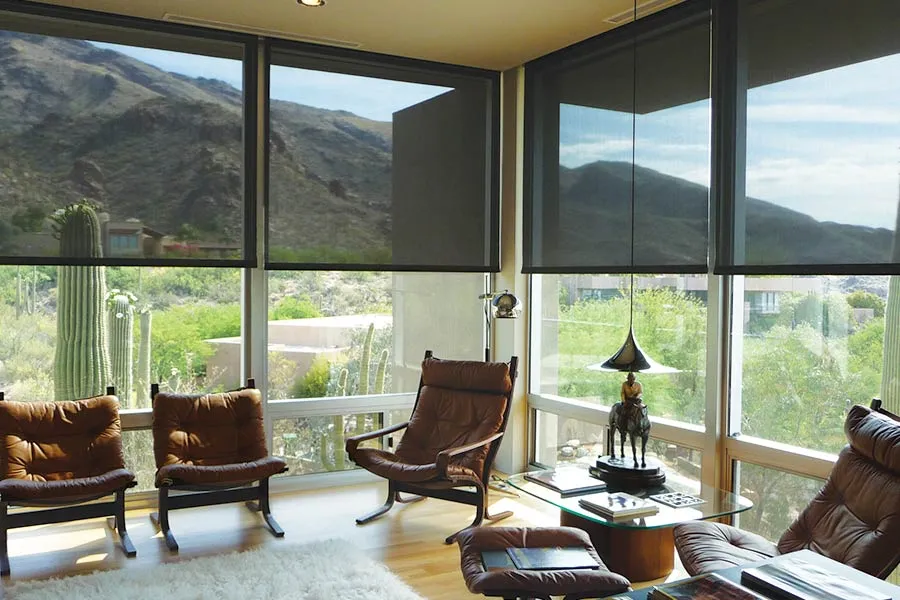
The daytime privacy benefit is a byproduct of the same physics. Because the interior of a home is darker relative to the bright exterior during the day, occupants inside can see out clearly through the mesh while people outside looking in see primarily the dark screen surface. The effect reverses at night when interior lights are on. Worth knowing before specifying a screen on a bedroom window where nighttime privacy matters — a secondary interior shade handles that gap without sacrificing the solar performance of the exterior screen.
Key takeaway
Exterior solar screens stop solar heat before it reaches the glass; interior window treatments only manage heat after it is already inside — which is why windows account for 25–30% of residential cooling energy use and exterior placement is the stronger fix.
Chapter 3 · Selection
Matching Openness Factor and Screen Density to Window Orientation
Installing the same screen density on every window in your home is the most common solar screen mistake — and it costs you in two directions at once. Maximum-density screens on north- and east-facing windows over-darken rooms that rarely face direct sun, while under-specified screens on the west wall leave the worst heat load essentially unmanaged. The right approach matches openness factor to window direction, which means you need a simple orientation framework before you order a single screen. Sun shades and solar screens for windows are not one-size-fits-all products — orientation is everything in desert climates.
West and south: the heaviest sun loads
West-facing windows take the most intense afternoon and evening sun in desert climates — the sun angle is low in the west, so the sun's rays penetrate deeply into rooms rather than hitting them at a glancing angle. These windows need the strongest exterior solar screens: a 3% openness fabric (roughly 97% heat and UV protection) is the standard recommendation for west glass in Arizona. South-facing windows carry a heavy load year-round and typically call for an 80–90% shading factor, which corresponds to 5–10% openness fabric depending on how much view matters to the occupant.
East-facing windows catch the morning sun, which is cooler and at a lower intensity than afternoon west exposure. An 80% shading factor — 10% openness fabric — is usually sufficient here, and it preserves more natural morning light in rooms like kitchens and breakfast areas. North-facing windows rarely receive direct sunlight at Arizona latitudes; a standard insect screen or a very open solar mesh is typically all that is needed, and heavy solar screens on north glass serve no heat-control purpose while making those rooms noticeably darker.
A worked example: Tucson ranch home by room
A Tucson ranch home with a living room on the west wall and a kitchen on the east would do well with 3% openness Mermet fabric on the living room windows and 10% openness on the kitchen. The home office on the south side might take 5% — enough to cut glare on a monitor without making the room feel like a cave. Mixing densities by orientation costs nothing extra in a custom-manufactured retractable system, and it delivers better whole-home comfort than a one-size-fits-all approach. Quantity of screens matters less than matching the right fabric to each exposure.
Fabric color adds another layer to the decision. Darker colors — charcoal, dark brown — absorb more heat from the mesh itself but provide a noticeably cleaner view through the screen from the inside out during daylight. Lighter colors reflect more solar radiation from the fabric surface but create more glare on the interior side and reduce outward visibility. For most Arizona applications, darker mesh performs better and feels better to live with daily, which is why TRSS uses primarily darker color options in its Solution Screen product line.
Openness factor also determines UV protection for interior surfaces. Floors, rugs, furniture, and artwork fade from cumulative UV exposure — a gradual process that feels invisible until a rug is moved and the unfaded patch underneath shows the damage. A 5% openness Mermet fabric blocks roughly 95% of the sun's UV rays; a 3% fabric blocks roughly 97%. On a south or west window where fading is a real risk, that extra protection pays for itself in preserved flooring and furnishings over the life of the home.
Key takeaway
West-facing windows in Arizona need 3% openness fabric for roughly 97% UV protection; south and east windows typically call for 5–10% openness — using the same density on every window over-darkens low-sun exposures and under-protects the worst ones.
Chapter 4 · Solar Screen Material
Solar Screen Material, Frame, and Mounting: What to Evaluate Before You Buy
Choosing the right mesh openness factor is half the decision; the other half is what the screen is made of, how it is framed, and how it attaches to your home. Those factors determine whether the screen still performs correctly in year five or year ten. In the Arizona desert, screens face months of sustained UV, 110-degree heat, monsoon dust, and wind loading that expose every weakness in a cheap frame or low-grade fabric. Durability is not a marketing claim here — it is a function of the material choices made at spec time.
Fiberglass-core solar screen fabrics outperform polyester-core in desert climates for two reasons: they are more heat-stable under sustained direct sun, resisting the sagging and stretching that plagued earlier polyester products, and their thinner yarn construction produces a cleaner view-through at any given openness rating. Mermet fiberglass fabrics — the Natte (classic 2x2 basketweave) and Satine (decorative twill) lines used in TRSS Solution Screens — carry a 10-year no-fade warranty, which is a meaningful durability claim in a region where lesser fabrics chalk and discolor within two or three seasons.
Solar screen frame and bracket construction
The solar screen frame matters as much as the fabric. Aluminum extrusion frames are the standard for exterior solar screen panels; they resist corrosion, do not warp in heat, and can be powder coated to match a home's exterior color scheme. The frame width and corner-join method affect rigidity on larger openings — a flimsy frame on a wide screen will rack and bow under wind, letting gaps form at the edges where the mesh meets the window frame. For retractable systems, the housing that contains the rolled screen and the side guide channels must be sized to handle the width of the opening without binding. Brackets attach the housing to the wall or window casing; on stucco construction, the fastener type and stucco-penetration method matter for long-term hold.
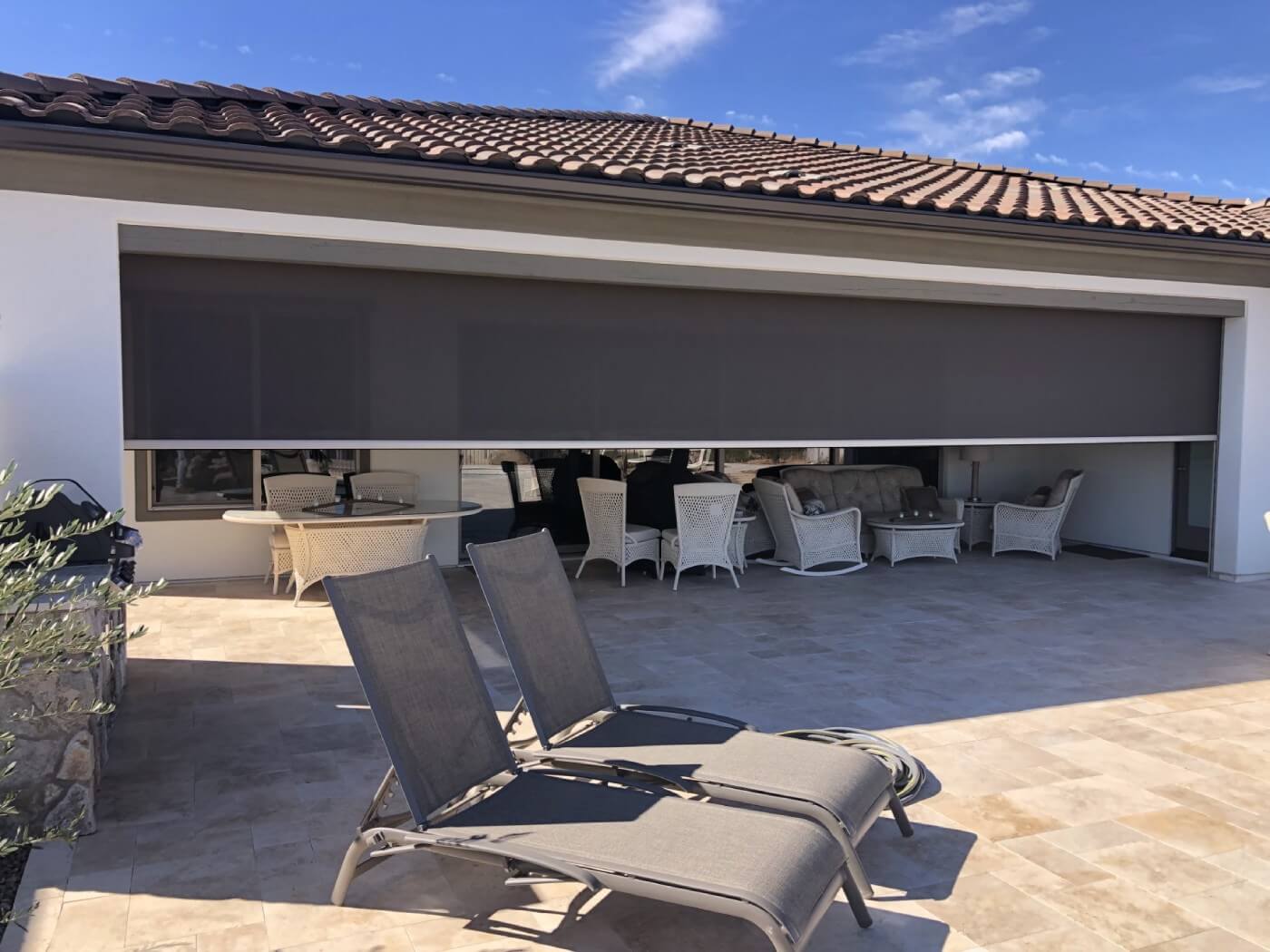
For retractable screens on outdoor surfaces like patios and covered openings, a level floor is rarely guaranteed. TRSS's patented Tucson Adjustable Bottom Bar (Patio TABB) solves this directly: the self-leveling bottom bar automatically adjusts for slope and seals the gap at the base against dust and pests, then returns to level automatically when the screen retracts. It is available on Solution Screens up to 17 feet wide. On sloped or uneven patio surfaces, this feature is what separates a screen that actually seals from one that lets wind-blown dust through the bottom.
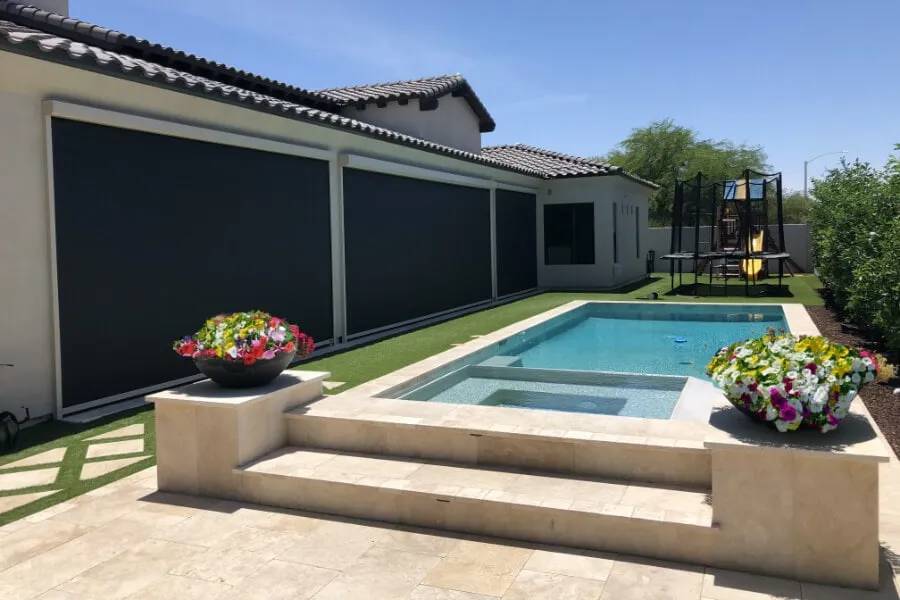
Mounting method depends on window type and construction. Fixed exterior solar screen panels typically attach to the window frame using brackets and screws, with the screen framed to fit snugly against the exterior casing. The air gap between screen and glass must be maintained — pressing the screen flush against the glass defeats the heat-shedding mechanism described in Chapter 2. Retractable screens mount the housing above the opening and run guide channels down the sides, attaching to the wall or frame with brackets. On new construction, recessed housing is an option — the screen rolls into a pocket built into the wall or soffit. On existing homes, surface-mount housing is the standard approach and works on virtually any wall construction.
Motorization is worth evaluating at the time of installation, not as an afterthought. TRSS Tucson Signature Series Motors and Electronics carry a lifetime warranty and integrate with Bond Bridge Pro for smart-home control via Wi-Fi, Alexa, and Google Home. Adding motorization to a retractable screen at install time adds cost but no structural complexity; retrofitting a motor later often requires removing the screen housing. If a screen covers a large patio opening or a window that is hard to reach, the convenience case for motorization is straightforward — and the lifetime warranty removes the durability concern that makes some homeowners hesitant.
Key takeaway
Fiberglass-core fabrics like Mermet's Natte and Satine resist sagging and carry a 10-year no-fade warranty in desert heat — and a sturdy aluminum frame with proper brackets is what keeps the screen sealed and effective for a decade.
Chapter 5 · Installing Solar Screens
Installing Solar Screens: Cost, Process, and What to Expect in 2026
Professional installation of exterior solar screens runs $50–$150 per window for standard sizes in 2026, with larger or custom openings reaching $80–$280 per window (HomeGuide, 2026). Those figures cover fixed-panel exterior screens; retractable motorized systems on wide patio openings are priced per project and vary significantly by system size, motorization, and housing type. Understanding what drives cost — and what a low quote usually skips — is the difference between buying once and buying twice.
The price range on a fixed exterior solar screen panel breaks down into fabric, frame, hardware, and labor. Fabric and frame material make up most of the product cost; the openness factor and fabric brand move that number. Labor is the variable most affected by access: a ground-floor window with clear access takes less time than a second-floor window requiring a ladder setup. Custom sizes cost more than standard sizes because they require custom-cut frames rather than off-the-shelf extrusions. When comparing quotes, confirm that the frame material, fabric brand and openness factor, and warranty terms are identical — otherwise you are comparing different products at similar prices.
TRSS Solution Screen system sizes
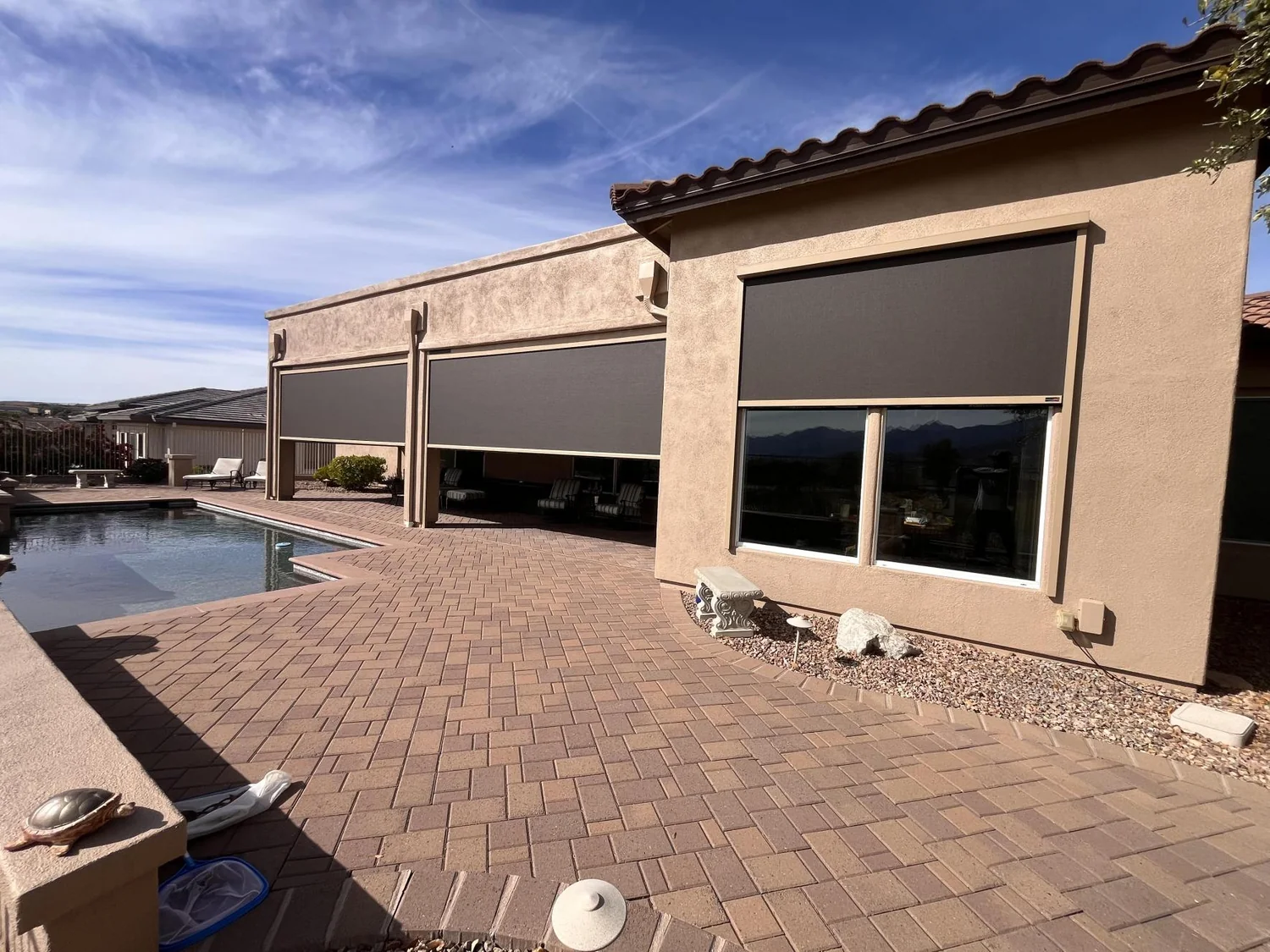
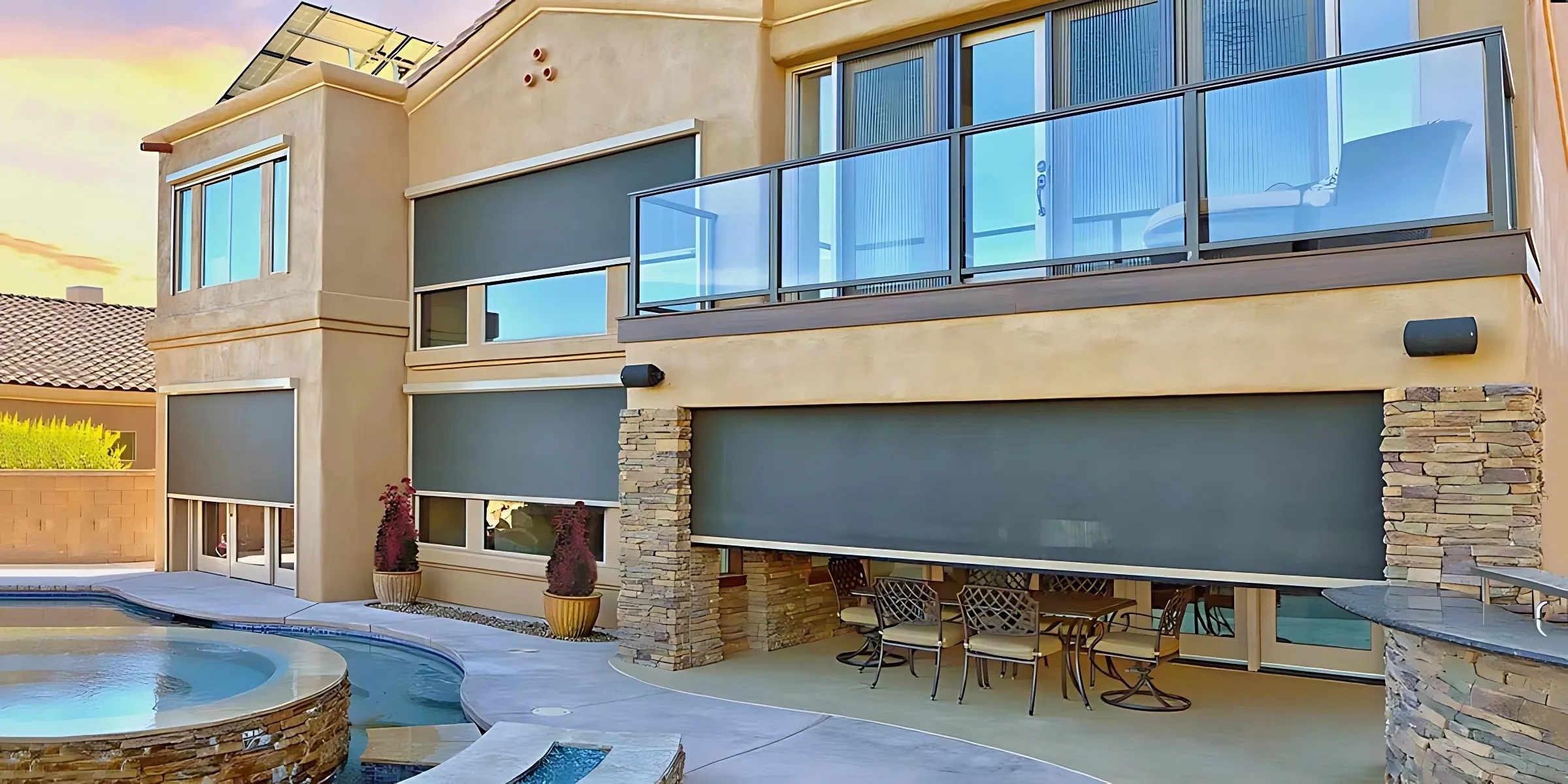
Retractable solar screen systems like TRSS Solution Screens are priced at a higher level than fixed panels because they include a housing, guide channels, a bottom bar assembly, and optionally a motor and smart-home integration. The s4 Solution Screen handles openings up to 16 feet wide and 10 feet tall; the s5 covers up to 19 feet wide by 16 feet tall; the s56 reaches 24 feet wide by 16 feet tall; and the s7 handles up to 32 feet wide by 20 feet tall. That size range spans a single bedroom window all the way to a full commercial restaurant patio enclosure. The right system size is determined by the opening width, not by guessing — a site measurement is the starting point before any quote is generated.
DIY installation of fixed solar screen panels is possible using standard tools: a tape measure, a drill, appropriate screws or brackets for the wall material, and a level. The process involves measuring the window frame accurately, ordering panels cut to size, and attaching brackets to the exterior frame before snapping or screwing the screen panel in place. The gap between the screen and the glass should be maintained — pressing the screen flush against the glass defeats the air-gap heat-shedding mechanism. Retractable systems are not DIY projects: the housing alignment, guide channel tension, and bottom bar calibration require installation experience to set correctly, and a misaligned system will bind, skip, or fail to seal at the base.
The practical advice for most Tucson and Phoenix homeowners: request a free in-home estimate before ordering anything. Window frame sizes vary more than homeowners expect, orientation-based density decisions are easier to make with someone who has seen thousands of Arizona homes, and the fabric and system size recommendations differ meaningfully by application. TRSS has built every product it installs in Tucson since 1979, which means the estimator recommending your screen is the same organization that manufactures and installs it — not a reseller working from a catalog. That matters when the instructions say one thing and the site conditions say another.
Key takeaway
Fixed exterior solar screen installation runs $50–$150 per window in 2026 for standard sizes; retractable systems scale with opening width and motorization — and a site measurement before ordering is the step most homeowners skip that causes the most problems.
Chapter 6 · Energy Savings
What to Expect: UV Protection, Energy Savings, and Honest Tradeoffs
Exterior solar screens deliver real, measurable benefits in hot-climate homes — reduced cooling load, UV protection for interior surfaces, daytime privacy, and glare control — but they also come with tradeoffs worth knowing before you install. This chapter addresses the honest version of both sides: what solar screens can help reduce, what they cannot do, and how to set accurate expectations so the installation actually delivers what you wanted. Energy savings and UV protection are the headline benefits; light reduction and nighttime visibility are the headline tradeoffs.
UV protection: specific numbers by openness factor
On UV protection, the numbers are specific. Mermet fiberglass fabrics at 10% openness block roughly 90% of the sun's UV rays; at 5% openness, roughly 95%; at 3%, roughly 97%; and at 1%, up to 99%. For flooring, furniture, rugs, and art in direct sun exposure, that level of UV protection meaningfully slows fading. It will not reverse damage that has already occurred, but installed on a south or west window before significant fade has set in, a quality solar screen preserves interior surfaces for the life of the home. The rating is not marketing — it reflects the fabric's measured transmittance at each openness level.
On energy savings, the honest framing is 'can help reduce' rather than a fixed number. Exterior solar screens can block up to 65–90% of solar heat gain depending on mesh density, which translates to real improvement in energy efficiency for most Arizona homes. Homeowners in hot climates report 15–25% reductions in monthly energy bills after installation, but that range reflects houses with different insulation levels, HVAC efficiency, and window counts. A well-oriented Tucson home with a heavy west-wall window load and an aging AC unit will see a larger impact than a well-insulated Phoenix home with a newer system. The screens reduce the load on the AC — that is consistent — but how much that shows up in your energy bills depends on the full picture of your home.
The main tradeoffs: light, visibility, and nighttime privacy
Lower openness factor means less natural light and a slightly more restricted outward view. A 3% screen on a west window will noticeably reduce light levels in that room compared to no screen. That is a feature when the alternative is squinting through a baking-hot wall of afternoon sun, but it is worth knowing. Most homeowners who install a 5% screen in a living space find the light level comfortable; 3% feels darker but is usually acceptable in a family room or bedroom where heat control matters most. The 1% fabric is for applications where maximum blockage is the priority and the view is secondary — a utility room, a west-facing garage window, or a commercial patio where shade comfort matters more than sightlines.
Night visibility is the most commonly misunderstood tradeoff. The daytime one-way privacy effect — where you can see out but outsiders cannot easily see in — reverses at night when interior lights are on and there is darkness outside. The mesh becomes more transparent from the exterior. For bedrooms or spaces where nighttime privacy is a priority, a secondary interior window covering is the answer rather than avoiding exterior solar screens altogether. The two layers work together well: the exterior screen handles heat and UV during the day, the interior shade handles nighttime privacy. That combination is more effective than either product alone, and it covers the one gap that exterior solar screens cannot address on their own.
Key takeaway
Exterior solar screens with Mermet fiberglass fabric at 5% openness block roughly 95% of UV and can help reduce cooling costs by 15–25% in hot climates — but nighttime privacy reverses the one-way visibility effect, so bedrooms often benefit from a secondary interior shade.
Mini-glossary — terms you will see throughout this guide
Openness Factor
The percentage of a solar screen mesh that is open space. A 5% openness factor means 5% of the fabric surface is open and 95% is solid yarn — blocking roughly 95% of solar heat and UV. Lower openness means more heat blocking but reduced outward visibility.
Solar Heat Gain
The increase in thermal energy inside a building caused by solar radiation passing through windows. Exterior solar screens intercept solar heat before it reaches the glass, reducing the heat gain that drives up cooling costs in desert climates.
Mermet Fabric
A fiberglass-core solar screen fabric manufactured by Mermet, available in Natte (basketweave) and Satine (twill) weave styles. Used in TRSS Solution Screens; carries a 10-year no-fade warranty and is available in 1%, 3%, 5%, and 10% openness factors.
Solution Screen
TRSS's line of retractable exterior solar screens, manufactured in Tucson. Available in four system sizes (s4 through s7) covering openings from standard windows up to 32 feet wide, with Mermet fiberglass fabric options and optional motorization.
Tucson Adjustable Bottom Bar (Patio TABB)
A patented TRSS feature on retractable Solution Screens that automatically self-levels to compensate for uneven or sloped patio surfaces, sealing the bottom gap against dust and pests. Available on systems up to 17 feet wide and returns to level on retraction.
Tucson Signature Series Motors and Electronics
TRSS's proprietary motorization system for retractable solar screens and rolling shutters, backed by a lifetime warranty. Compatible with Bond Bridge Pro for smart-home integration via Wi-Fi, Alexa, and Google Home.
Bond Bridge Pro
A smart-home hub used with TRSS motorized screens and shutters to enable Wi-Fi, Alexa, and Google Home control. Allows automated scheduling and remote operation of retractable solar screens.
Air Gap
The space between an exterior solar screen mesh and the glass surface. This gap allows the screen to shed absorbed heat to outdoor air rather than radiating it inward — a key reason exterior placement outperforms interior window treatments on heat rejection.
UV Protection Rating
The percentage of the sun's UV rays blocked by a solar screen fabric. Mermet fiberglass fabrics at 10% openness provide roughly 90% UV protection; at 1% openness, up to 99%. UV protection directly affects how much fading interior surfaces like floors and furniture experience over time.
Shading Factor
A shorthand percentage describing how much solar heat a screen blocks, derived from its openness factor. A screen with 10% openness has an 80–90% shading factor; 3% openness corresponds to roughly 97% shading. Used interchangeably with 'heat rejection percentage' in the field.
Retractable Solar Screen
An exterior solar screen mounted in a housing that allows the mesh to roll up when not needed, using manual or motorized operation. TRSS Solution Screens are retractable systems; they protect openings when deployed and disappear into the housing when retracted, preserving views and curb appeal.
Window Frame (Exterior Mount)
The structural surround of a window on the building exterior, to which fixed exterior solar screen panels are attached using brackets and screws. The frame must be in sound condition to hold the screen panel securely and maintain the air gap between mesh and glass.
Don't Let Orientation Be an Afterthought
The most expensive solar screen mistake is not buying the wrong fabric — it is installing the same screen on every window without considering which direction each one faces. A 3% openness screen on a north-facing bedroom adds no heat-control benefit and makes the room noticeably darker year-round. The same screen on a west-facing living room is exactly right. Before ordering any solar window screen, map your home's window orientations and match the openness factor to the sun load each window actually receives. If you are not sure, a free in-home estimate from TRSS includes that orientation assessment — it is part of how we spec every project.
For Tucson and Phoenix homeowners facing intense desert sun, baking rooms, and cooling bills that spike every summer, exterior solar window screens from Tucson Rolling Shutters and Screens address the problem at the source — stopping solar heat before it ever touches the glass. TRSS has engineered and built its Solution Screens in Tucson since 1979, using Mermet fiberglass fabrics with a 10-year no-fade warranty, the patented Tucson Adjustable Bottom Bar, and Tucson Signature Series Motors with a lifetime warranty. About 70% of TRSS business comes from referrals and repeat customers — because a product built for this exact climate, by the people who manufacture it, tends to hold up. Book a free in-home estimate at tucsonrollingshutters.com/contact-us or call (520) 297-2828 to get a site measurement, an orientation-based fabric recommendation, and a quote on the right system for your home.
Frequently Asked Questions
How much do solar screens cost per window in 2026?
Professional installation of fixed exterior solar screens runs $50–$150 per window for standard sizes in 2026, rising to $80–$280 for larger or custom openings (HomeGuide, 2026). Retractable motorized systems — like TRSS Solution Screens — are priced per project based on opening width and system size, since the housing, guide channels, bottom bar, and optional motor all add to the cost. The fabric openness factor and frame size move the price within any range; a 1% openness fiberglass panel on a large west-facing picture window costs more than a 10% panel on a standard east-facing bedroom window. Get a site measurement before budgeting — window frame sizes vary more than most homeowners expect, and a quote based on inaccurate measurements leads to refabrication costs.
What are the disadvantages of solar shades and exterior solar screens?
The main tradeoffs are reduced natural light and restricted outward visibility — both are direct results of the mesh density doing its job. A 3% openness screen blocks roughly 97% of heat and UV, but it also noticeably darkens the room compared to no screen at all. The second tradeoff is nighttime privacy: the daytime one-way effect (you can see out, outsiders can't easily see in) reverses after dark when interior lights are on. For bedrooms, a secondary interior shade solves this. Fixed exterior panels also change the exterior appearance of the home, though darker charcoal mesh is visually clean on most stucco and painted facades. Retractable systems address the curb-appeal concern by rolling into a housing when not deployed.
Can you see out of solar screens during the day?
Yes — during daylight hours, the view outward through a solar screen is clear to the occupant inside. The effect works because the interior of a home is darker relative to the bright exterior, so you see through the mesh without difficulty while outsiders looking in see primarily the dark screen surface. The clarity of the view depends on the openness factor: a 10% openness screen provides the clearest view-through, while a 3% or 1% screen is noticeably denser and slightly more restrictive. Darker fabric colors (charcoal, dark brown, black) also improve daytime view-through compared to lighter colors, which is why most quality Arizona installations use dark mesh. At night with interior lights on, this privacy effect reverses.
What is the best openness factor for solar screens in Arizona?
The right openness factor depends on which direction the window faces. West-facing windows — the most punishing exposure in desert climates — call for 3% openness fabric, which blocks roughly 97% of solar heat and UV. South-facing windows typically take 5% openness for a balance of heat control and comfortable light levels. East-facing windows usually do well with 10% openness, which blocks around 90% of heat while preserving more of the morning light. North-facing windows in Arizona rarely receive direct sun and don't need heavy solar screening at all. Installing the same density across every window is the most common mistake: it over-darkens low-sun rooms while leaving the worst heat loads under-protected.
How long do exterior solar window screens last?
Quality fiberglass-core solar screen fabrics like Mermet's Natte and Satine lines carry a 10-year no-fade warranty — a meaningful durability claim in Arizona, where sustained UV and 110-degree heat expose every weakness in a lesser fabric. Polyester-core screens cost less upfront but are more prone to chalking, discoloring, and stretching within two to three seasons under direct desert sun. The aluminum extrusion frame resists corrosion and won't warp in heat; the frame's durability depends more on the corner-join construction and bracket quality than on the extrusion material itself. Motorized systems from TRSS carry a lifetime warranty on the Tucson Signature Series Motors and Electronics. Proper installation — maintaining the air gap between mesh and glass and securing brackets to sound window frame material — is what determines whether a screen holds its shape and seal for a decade.
How do I measure for solar screens, and can I install them myself?
For fixed exterior solar screen panels, measuring requires a tape measure and care: measure the width and height of the exterior window frame at multiple points, since frames are rarely perfectly square. Order panels cut to those dimensions, allowing for the specific bracket or clip mounting system being used. Basic tools — a drill, appropriate screws or brackets for the wall material, and a level — handle the installation. The key is maintaining the air gap between the screen and the glass rather than pressing the mesh flush against the surface. Retractable solar screen systems are not suitable for DIY installation: the housing alignment, guide channel tension, and bottom bar calibration require hands-on experience to set correctly, and a misaligned system will bind or fail to seal. For retractable systems, a free in-home estimate and professional installation is the right starting point.