MENU

Solar screen fabric performance is controlled by three specs: openness factor (the percentage of open weave — lower means tighter blocking), color (dark fabrics absorb solar energy for better glare control; light fabrics reflect more heat), and SHGC, the combined heat score that captures both variables. For Tucson and Phoenix homes, west-facing windows call for 1% openness, south- and east-facing windows suit 3–5%, and north-facing windows work well at 10%. Exterior solar screens stop the sun's heat before it crosses the glass — interior drapes and blinds cannot do that, which is why exterior shading reduces solar heat gain by up to 77% compared to 15–45% for interior solutions. TRSS installs Mermet fiberglass-core fabrics backed by a 10-year no-fade warranty.
Solar screen fabric product pages are full of numbers — 3%, 5%, SHGC 0.18, Rs 42%, UV 97% — and almost none of them explain what those numbers mean for the room on the other side of the glass. This guide closes that gap. It explains the three specs that actually control solar screen performance — openness factor, color, and SHGC — uses the Mermet fabrics TRSS installs as the worked example, and ends with a room-by-room decision framework that tells you exactly which fabric fits which window in a Tucson or Phoenix home. Read time is 15–20 minutes. No technical background required.

Exterior solar screens stop the sun's heat before it crosses the glass — interior drapes and blinds cannot do that, because by the time sunlight passes through glass it has already become heat inside your room. That physical difference is why exterior shading reduces solar heat gain through west-facing glass by up to 77%, while interior blinds reduce it by only 15–45%. Once you understand that mechanism, the fabric specs on the label make intuitive sense: every number describes how much of the incoming solar energy the fabric intercepts, reflects, absorbs, or lets through.
In Tucson and Phoenix, west-facing windows take the hardest afternoon sun — often direct exposure for four to six hours per day in summer. That is the scenario where fabric choice shifts from preference to an engineering decision. A screen that works fine on a north-facing wall may do almost nothing useful on a west-facing wall if the openness and color are not matched to the load. The steps below walk through each spec in the order that matters: openness first, then color, then the combined heat number (SHGC), and finally the room-by-room decision framework.
Arizona's UV intensity is among the highest in the country year-round, not just in summer. Fabric that performs adequately in a milder climate can still allow significant heat gain and UV damage here. The specs on the label are your only tool for comparing fabrics before installing, so reading them correctly saves you from choosing the wrong fabric for the wrong window — and from spending money on a replacement.
Openness factor is the percentage of open space in a solar screen fabric's weave. A 5% fabric has 5% open area and 95% solid yarn. That single number controls four things at once: UV protection, solar heat transmittance, glare control, and view-through clarity. Lower openness means a tighter weave, which means more blocking across all four. The relationship between openness and UV blockage is nearly inverse — a 1% fabric blocks up to 99% of UV rays, a 5% fabric blocks roughly 95%, and a 10% fabric blocks roughly 90%.
TRSS's Solution Screen lineup uses Mermet fabrics in four openness levels: Satine 5701 at 1% (99% heat and UV protection), Natte 4503 at 3% (97%), Natte 4505 and Satine 5705 at 5% (95%), and Natte 4500 at 10% (90%). Each step up in openness percentage trades a bit of heat and glare blocking for a bit more view and light. The trade is real and measurable — it is not a marketing spectrum. The right choice depends on what the window faces and what you want the room to feel like. Comparing openness factors side by side on spec sheets is the fastest way to narrow the field before ordering.
One thing openness factor does not control: nighttime privacy. When interior lights are on after dark, any openness level — including 1% — allows visibility from outside. This is the most common misconception homeowners have before they select fabric, and it is worth settling before the install. Openness ratings describe daytime performance only. For nighttime privacy, a separate interior shade or roller blind is what you need.
Free
Seeing the weave density and color in your actual light conditions is the fastest way to calibrate your openness preference before committing to an order — no spec sheet can substitute for holding a 3% and a 5% charcoal against your window at the time of day when glare is worst.
Fabric color and openness factor are independent variables, but they interact. Openness tells you how much of the fabric is solid yarn — color tells you what that solid yarn does with the solar energy it catches. Dark yarns such as charcoal and bronze absorb more solar energy; light yarns such as white and beige reflect more of it back outside. This means two fabrics at the same openness percentage can have meaningfully different Solar Heat Gain Coefficients depending on color alone.
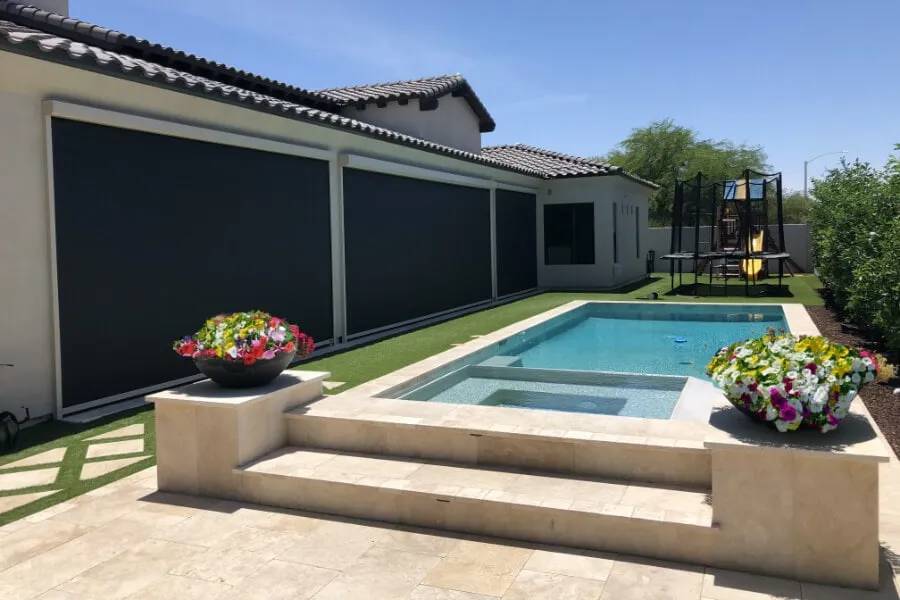
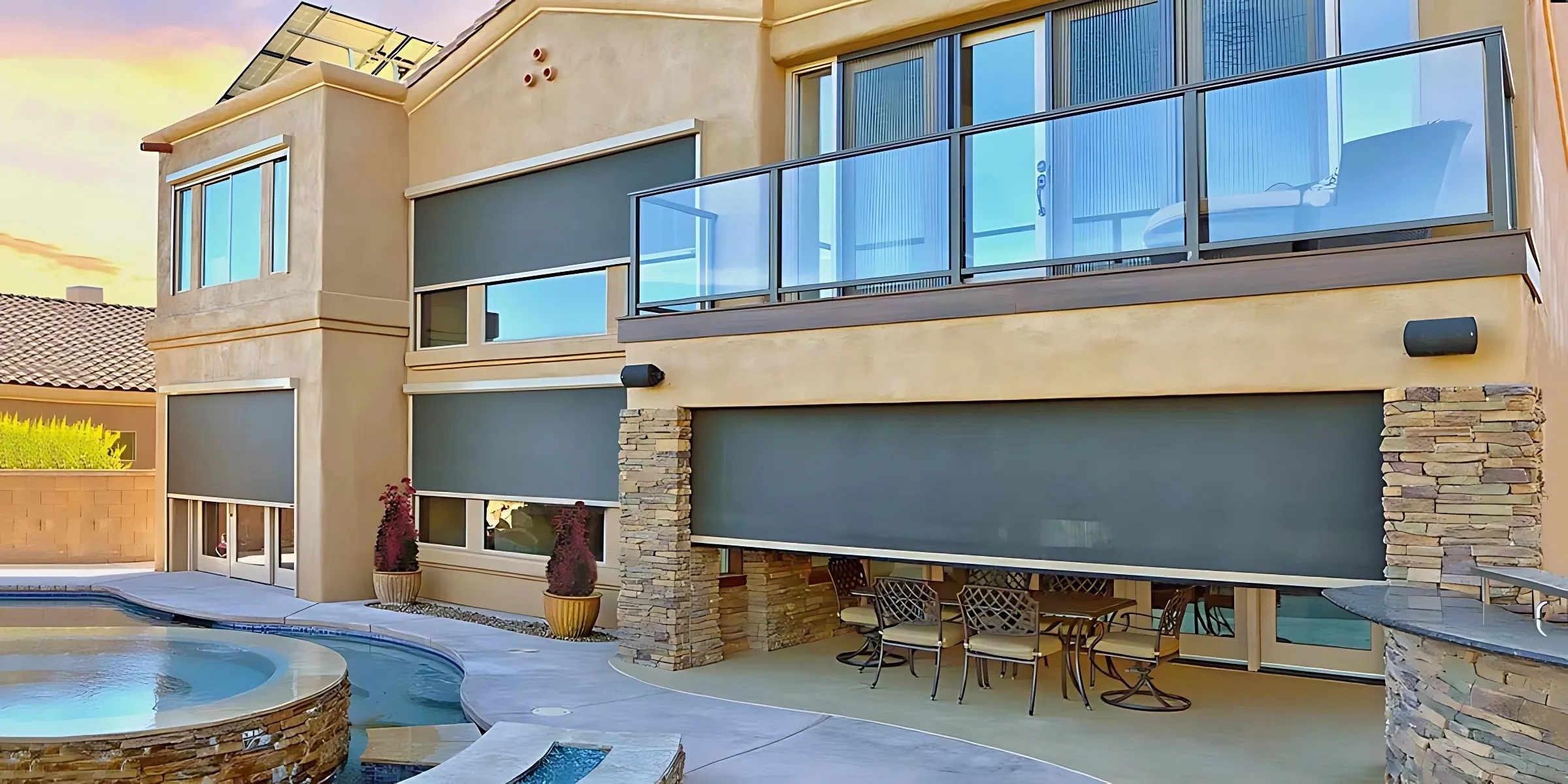
TRSS deliberately specifies mainly darker colors for its Solution Screens, and the reason is specific to how Tucson homeowners use their screens: darker fabrics deliver better glare control and a clearer outward view because they absorb light rather than scatter it. When a screen is deployed and you are sitting inside, a dark charcoal fabric at 5% openness gives you a sharper, more usable view through the screen than a light-colored fabric at the same openness — the absorbed light does not create the bright, diffuse glow that makes light fabrics look hazy from inside. Light fabrics reflect more solar energy outward, which can reduce heat gain slightly, but in Arizona's climate the glare and view problems matter just as much as the heat numbers.
A practical rule for most residential applications: if glare on a TV, monitor, or kitchen countertop is your main complaint, a darker fabric solves it more directly than a lighter one at the same openness. If maximum solar reflectance off the building envelope is the priority — more relevant for commercial facades or unshaded skylights — a lighter or metallized fabric may earn its place. For most windows and porches in Tucson, darker Mermet fabrics at 3% or 5% openness hit the comfortable sweet spot between performance and livability.
A 5% charcoal and a 5% white have exactly the same openness factor. Color only changes how the solid 95% of the yarn handles the energy it intercepts — not how much of the weave is open. A lighter color does not give you more view or more light. The openness number is the only spec that controls that, and it is the number to check first when comparing fabrics.

Solar Heat Gain Coefficient (SHGC) is the fraction of total solar radiation that passes through both the screen and the glass as heat into your room. Lower SHGC means less heat entering — it is the single number that captures the combined effect of openness and color. SHGC values for quality solar screen fabrics range from roughly 0.10 to 0.53 depending on weave and color, with darker, tight-weave fabrics at the low end. Mermet's 1% Satine fabric in a Granite colorway reaches an SHGC as low as 0.10 in exterior applications.
The SHGC spec sheet also shows three supporting metrics: Ts (solar transmittance — how much solar energy passes through), Rs (solar reflectance — how much bounces back outside), and As (solar absorptance — how much the fabric holds). These three always add up to 100%. A dark 3% fabric might show Ts of 3%, Rs of 25%, As of 72% — meaning it absorbs most of what it catches and reflects a modest amount back. Mermet M Screen fabrics achieve solar reflectance Rs values up to 76% in their lightest colorways, though at the cost of the view and glare performance described in the previous step.
For a homeowner comparing two fabrics on a product page, SHGC is the fastest shortcut. If both fabrics are the same openness but different colors, the one with the lower SHGC will keep the room cooler. If two fabrics are different openness levels but similar colors, the tighter weave will always win on SHGC. You rarely need to calculate anything — just compare the SHGC values on the spec sheet directly, and let that number confirm the choice your openness and color reasoning already pointed toward.
The right solar screen fabric is not the tightest one available — it is the one matched to what the window faces and what the room needs. West-facing windows that take direct afternoon sun are the hardest case, and 1% openness is the best bet here. Bedrooms, home offices with screen glare problems, and any room that bakes from mid-afternoon onward are all good candidates for Satine 5701 at 1% openness, which delivers 99% UV and heat blocking. A screen deployed on a west-facing wall can bring the outdoor temperature down by 10 to 15 degrees Fahrenheit under the shaded area — and that effect starts at the fabric, before any heat enters the glass.
South-facing and east-facing windows carry a lighter solar load in the afternoon, which is when rooms typically overheat. A 3% openness fabric is a strong all-around choice for these exposures — it blocks 97% of UV and heat while providing a usable, relatively clear outward view. Living rooms and main gathering spaces that face south or east are typical 3% applications. If the room gets good ventilation and the homeowner values a brighter, more open feel, 5% works well too, blocking 95% of UV and heat while letting in a bit more visible light. Both are comfortable choices for rooms that are not fighting the worst afternoon exposure.
North-facing windows receive little direct sunlight in Tucson — they are primarily about diffuse light and ventilation, not solar heat gain. A 10% fabric is ideal here: it still blocks 90% of harmful UV rays, protecting furniture, flooring, and furnishings from fading, while preserving a near-unobstructed view. Porches and pergola openings that face north or are naturally shaded by overhangs are also good candidates for 10% openness. For enclosed patios and sunrooms where Greenguard Gold air quality certification matters — Mermet's fabrics carry it — any openness level in the Mermet line qualifies. The point of the framework is to match the fabric's blocking strength to the window's actual solar load, not to choose the tightest option by default.
Free
Confirms the exact orientation of each window before you decide on fabric — east vs. southeast makes a real difference in afternoon heat load, and it takes 30 seconds to check.
Free
A TRSS technician assesses each window's orientation, sun exposure, and existing glass type to recommend the right Mermet fabric and openness level — removing the guesswork from a whole-house order.
Solar screen fabrics are not all the same material underneath the weave. Mermet Natte and Satine fabrics use a fiberglass core wrapped in vinyl coating. Fiberglass allows thinner yarns, which means more small openings per square inch for a given openness percentage, a cleaner and sharper view through the screen, and better resistance to sagging or stretching under direct desert sun compared to heavier polyester-core alternatives. In Arizona, where a screen may face sustained heat above 110 degrees Fahrenheit and monsoon wind loads, a fabric that holds its geometry over years is a structural requirement, not a nice-to-have. The widths available — up to 122 inches on Mermet's rolls — also mean fewer seams on large patio and sunroom openings, which matters both aesthetically and structurally.
The 10-year manufacturer's warranty on Mermet fabrics, covering defects, rotting, and fading, is a direct consequence of that material engineering. The fabric is fade resistant by specification, not by marketing claim — that 10-year no-fade warranty is one of the longest in the category. Most generic solar screen material sold online or through distributors carries a fraction of that coverage because the core and coating are not designed for the same conditions. TRSS backs every Solution Screen fabric with that warranty and combines it with a lifetime warranty on Tucson Signature Series Motors and Electronics. When comparing quotes, check whether the supplier is specifying Mermet or a generic equivalent — the openness percentages will look the same on paper.
The difference shows up after three Tucson summers, when a polyester-core fabric has started to sag in its frame and a fiberglass-core Mermet fabric still holds its original geometry and color. That is just what designed-for-this-climate means in practice: not a phrase on a website, but a material choice made before the rolls ship. Choosing the wrong fabric to save money up front usually means spending more on replacement within a few years — a tradeoff worth making explicit before anyone places an order.
Solar screens at 1–5% openness block 95–99% of harmful UV rays — the primary cause of fading in furniture, flooring, art, and window treatments. Blocking UV at the screen is far more effective than reducing it after it is already inside the room. If you have hardwood floors, rugs, or artwork near south- or west-facing windows, that is a reason to favor tighter openness even if heat is not your main complaint.

Spec sheets are essential, but openness percentages look different in a showroom than they do on a sun-loaded west-facing wall at 3 p.m. in July. TRSS provides fabric samples before any order is placed — ask for charcoal and bronze options in 3% and 5% side by side, hold them against your window at the time of day when glare or heat is worst, and the right choice usually becomes obvious. Ordering without samples is the most common mistake homeowners make when selecting solar screen fabric, and it is an easy one to avoid. Contact TRSS at tucsonrollingshutters.com/contact-us or call (520) 297-2828 to request samples or schedule a free in-home estimate.
When the specs click, the decision gets easy. Openness factor narrows the field based on your window's solar load. Color determines how the solid yarn handles what it catches, with darker fabrics winning on glare control and view clarity for most residential windows in this climate. SHGC confirms which fabric will keep the room cooler when openness is equal. TRSS has been installing Solution Screens using Mermet fiberglass-core solar screen fabric in Tucson since 1979, specifically for the desert conditions that push generic fabrics past their limits. Book a free in-home estimate at tucsonrollingshutters.com/contact-us or call (520) 297-2828 — a TRSS technician will assess each window's orientation and sun exposure and recommend the perfect fabric and openness level to make your home comfortable, beautiful, and protected year-round.
Ready to get started? Contact Tucson Rolling Shutters today.