Exterior Window Shades: Types, Fabrics, and How to Fit Them Right
Exterior Window Shades: Types, Fabrics, and How to Fit Them Right
💡 Quick Answer
Exterior window shades are fabric or slatted systems mounted outside the glass that stop solar heat before it enters the home. That placement is what separates them from interior blinds, which only fight heat that is already inside. The main types are retractable solar screen shades, rolling shutters, retractable patio screens, and SkyShades. Each solves a different problem: solar screens for daytime heat control with a view, rolling shutters for blackout and security, patio screens for large openings up to 32 feet wide, and SkyShades for overhead sun on pergolas. For Tucson and Phoenix homes, a 1%–3% openness factor Mermet fiberglass-core fabric is the standard choice for south- and west-facing windows.
📊 Key Takeaways
Six facts from this guide that change what you would do next — one per chapter, grounded in research and TRSS product specs.
55% vs. 18%
Exterior shades cut solar heat gain three times more than interior roller shades
Four shade types, four jobs
Solar screens, shutters, patio screens, SkyShades each solve a different problem
1%–3% OF for desert exposures
Dark fiberglass Mermet fabric blocks up to 99% UV on west- and south-facing windows
Add 1.5–3 inches per side outside mount
Measure to the nearest 1/8 inch or leave a permanent light gap
Wind sensors protect the shade
Auto-retract motorization prevents storm damage in desert wind gusts
Match product to opening size
The s7 Solution Screen system covers patio openings up to 32 feet wide
Lifetime warranty on motors
TRSS Tucson Signature Series Motors carry a lifetime warranty on motor and electronics
TRSS has built in Tucson since 1979
Desert-engineered products, manufactured locally, for Arizona's specific climate
Tucson and Phoenix homes face some of the most sustained solar exposure in the continental United States. South- and west-facing windows can push afternoon room temperatures well past what an air conditioner can easily offset — and the reason most interior window treatments fall short has nothing to do with their quality. It has to do with where they sit relative to the glass. This guide covers how exterior solar shades work, the four main product types available to Arizona homeowners, how to read fabric specs, how to measure correctly, and how to choose and match the right system to any opening from a single bedroom window to a 32-foot patio span. It also touches on sustainability: stopping heat before it enters the home is one of the most effective ways to reduce HVAC energy use year after year without adding mechanical equipment.
The pillar answer
Exterior window shades are fabric or slatted systems mounted outside the glass that stop solar heat before it enters the home — making them fundamentally different from interior blinds, which only fight heat that is already inside. This guide covers the main exterior shade types available to Tucson and Phoenix homeowners: retractable solar screen shades, rolling shutters, retractable patio screens, and SkyShades. It also explains how to read fabric openness factors, choose the right material for Arizona exposures, and measure windows correctly for an outside mount installation. Interior-only treatments, window film, and patio umbrellas are outside this guide's scope.
Chapter 1 · Mechanism
Why Exterior Solar Shades Outperform Interior Blinds on Heat
Exterior window shades reduce solar heat gain by roughly three times more than interior roller shades at the same window — and the reason comes down to where in the system the heat is stopped. The U.S. Department of Energy notes that interior treatments can be less effective at reducing heat gain than comparable exterior shading systems because they do not block direct sunlight until after it has already passed through the glass. Once sunlight crosses the glass, it converts to heat inside the room. An exterior shade intercepts that solar energy before it ever reaches the glass surface. An Oak Ridge National Laboratory study put the gap plainly: exterior shades reduced solar heat gain by about 55%, interior roller shades by about 18%, and insulating interior shades by about 23%.
The physics are straightforward. Sunlight becomes heat the instant it passes through glass — including onto closed interior blinds that then radiate warmth back into the room. At that point, your AC is fighting heat that is already inside. An exterior solar shade catches the solar energy at the fabric, outside the glass, and absorbs or reflects it before it converts to indoor heat. That is why the performance gap between exterior and interior window treatments is not marginal. It is structural.
A PNNL field study on three large south- and west-facing windows found that exterior fabric shades delivered daily HVAC cooling savings of 1.0 to 3.2 kWh compared to interior blinds alone. That translates to roughly 10% space-cooling savings when internal loads are included, and about 20% savings compared to completely unshaded windows. For a Tucson home running AC from May through September, those daily savings compound into a real reduction on summer power bills — without changing thermostat settings or adding mechanical equipment. The sustainability case is equally direct: less HVAC runtime year after year means fewer emissions and a lower carbon footprint for the home.
The practical takeaway for Arizona homeowners: interior blinds are not wasted, but they are the wrong first line of defense against desert sun. West- and south-facing windows in Tucson face some of the most intense sustained solar exposure in the continental U.S. Stopping heat outside the glass is the highest-leverage, most effective move available before any other upgrade — and it is what every exterior window shade product in this guide does, by design.
Key takeaway
Exterior shades block roughly 55% of solar heat gain versus about 18% for interior roller shades — a gap rooted in stopping heat before it crosses the glass, not after.
Chapter 2 · Types
The Four Main Exterior Window Shade Styles — and Which Problem Each Solves
Four distinct exterior shade categories cover most residential and commercial needs: retractable solar screen shades, rolling shutters, retractable patio screens, and SkyShades. Each solves a different primary problem. Picking the wrong category — say, an exterior solar screen for a homeowner who also needs nighttime blackout and storm security — means buying twice. Matching the product to the use case is the first decision, and it matters more than fabric color or motor brand. The chart below maps each type to its primary use case before the sections that follow go deeper.
Retractable Solar Screen Shades
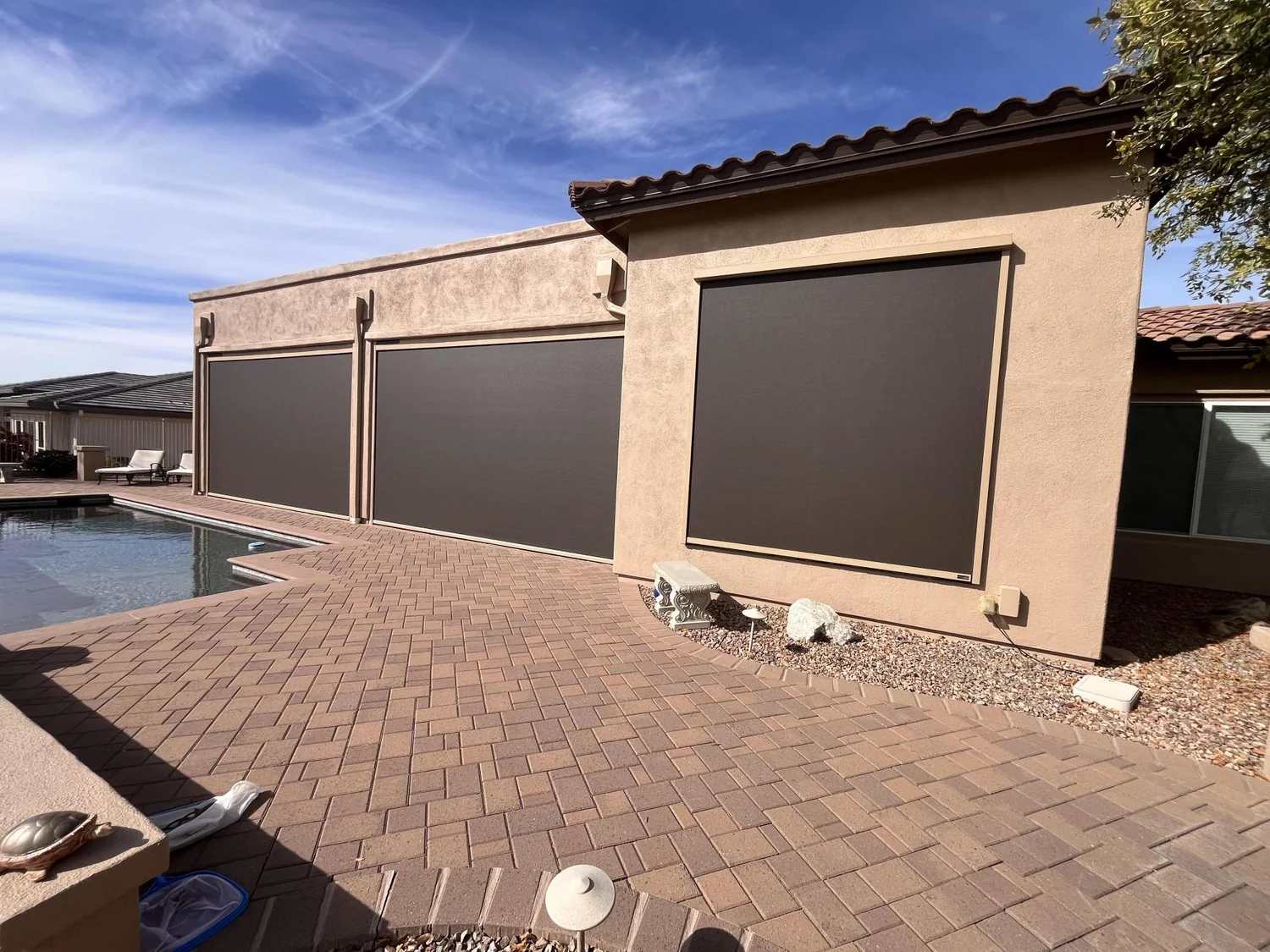
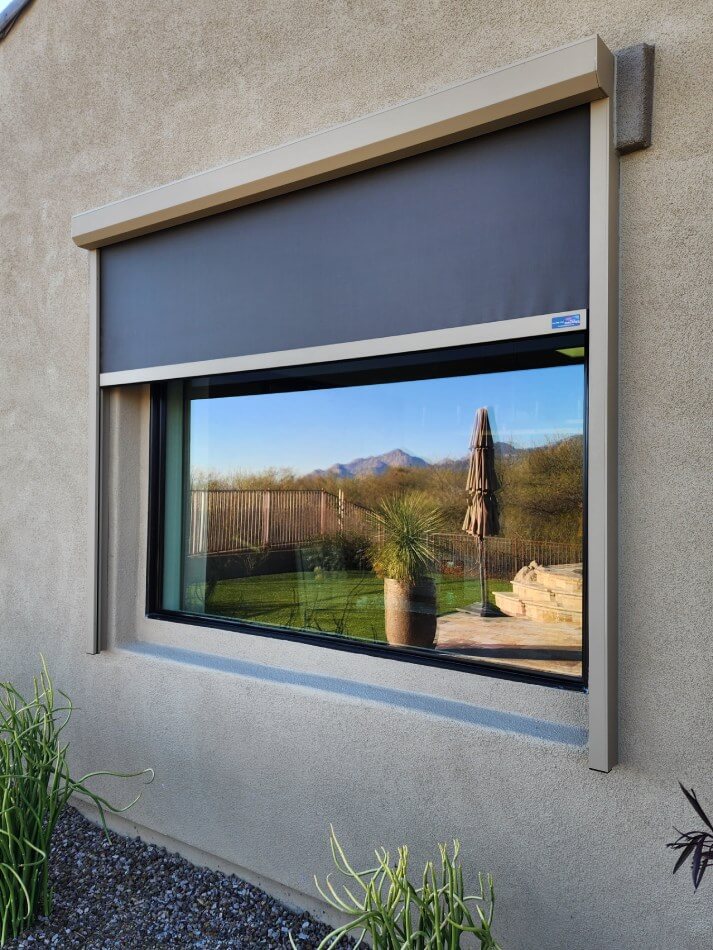
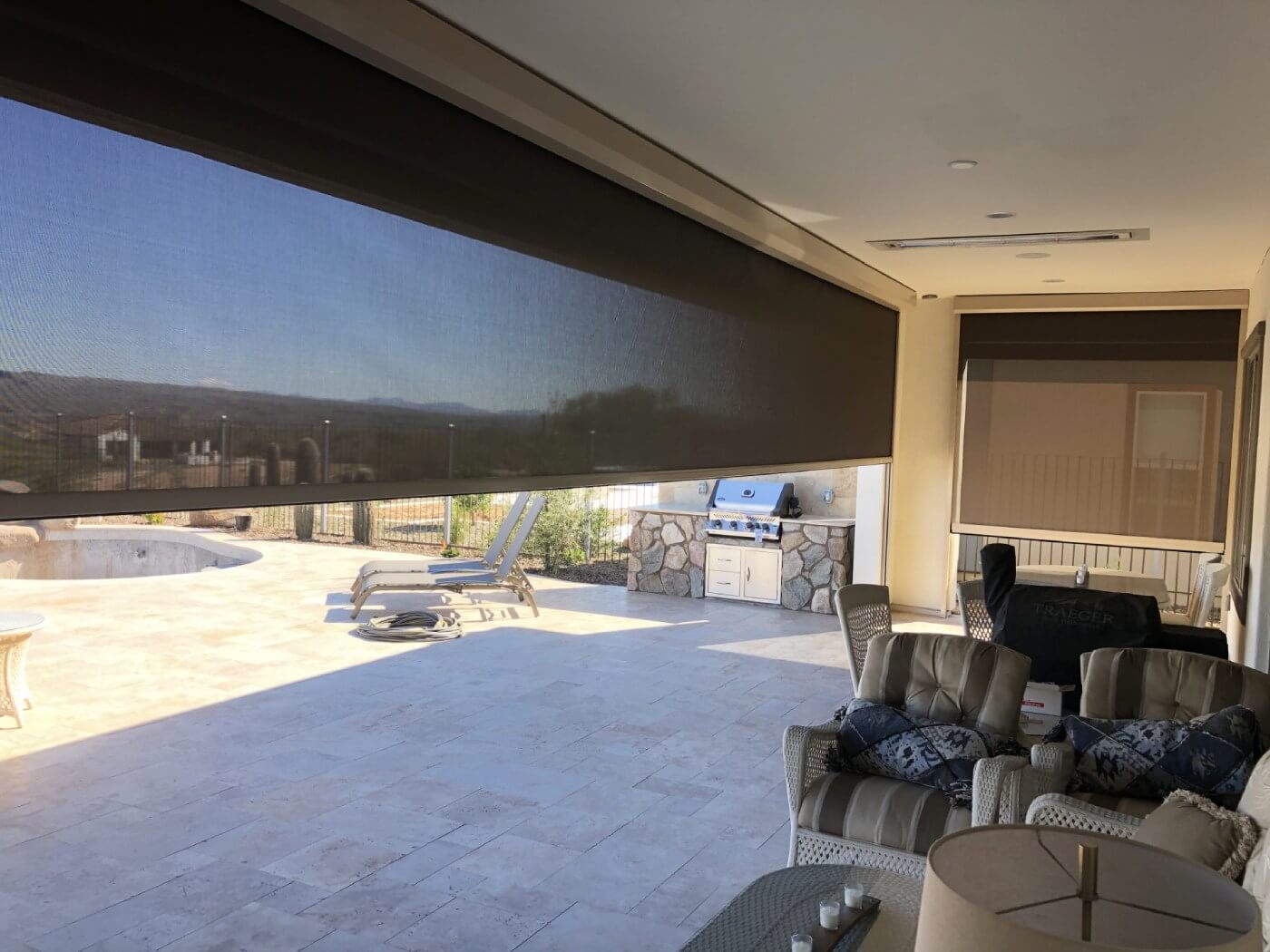
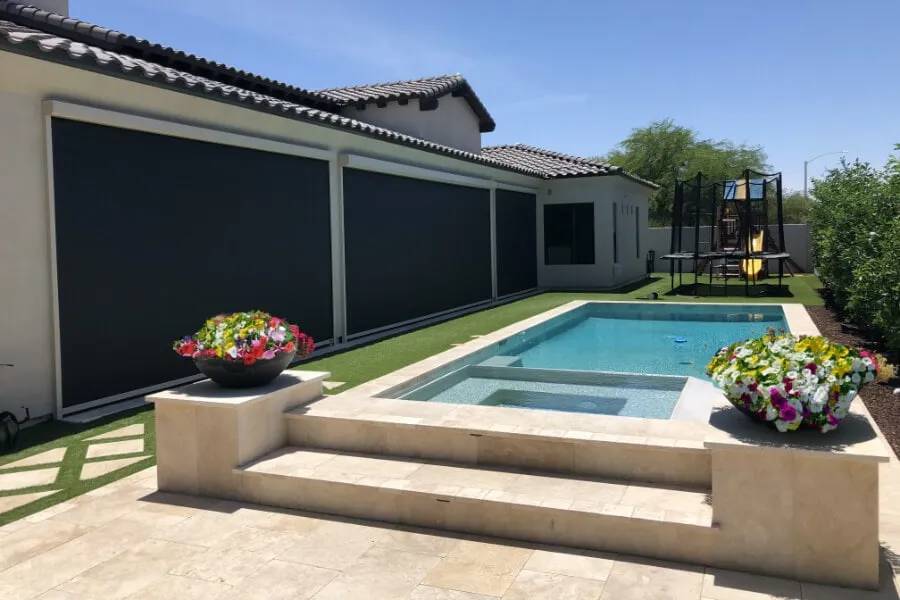
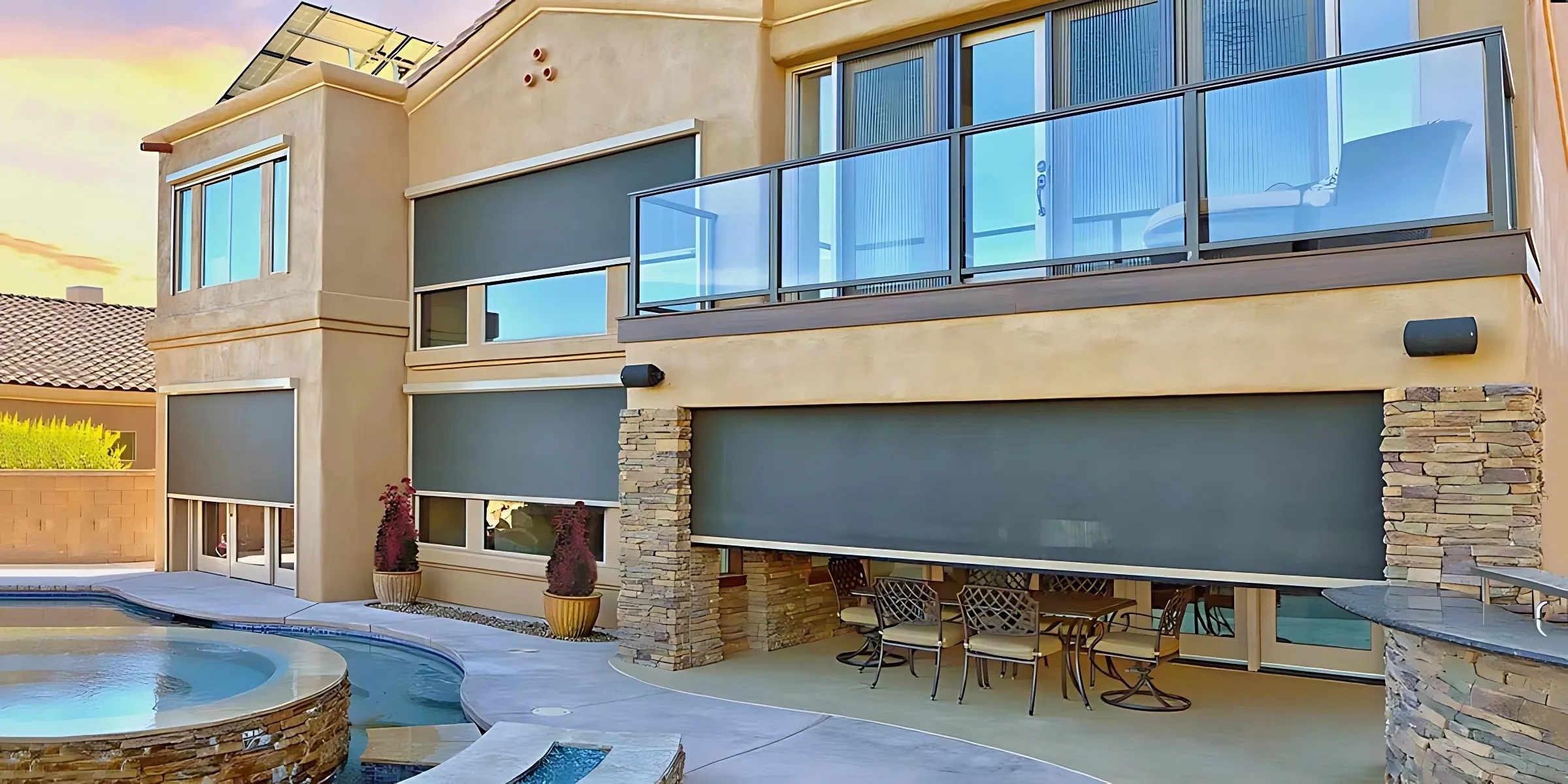
Retractable solar screen shades mount above a single window or door opening and roll down over the glass. The mesh fabric blocks heat and UV while preserving a one-way daytime view: you see out, but people outside cannot see in during daylight. This is the right choice for living rooms, home offices, and bedrooms with morning or afternoon sun — anywhere you want solar control without losing the sense of openness. TRSS calls these Solution Screens, and they come in four size configurations covering openings from standard windows (s4, up to 16 feet wide) up to large commercial spans (s7, up to 32 feet wide and 20 feet tall). The exterior solar shading they deliver is easy to adjust: a motorized system lowers or raises the screen in seconds.
Rolling Shutters
Rolling shutters use interlocking extruded aluminum slats that close fully over the window. Closed, they deliver complete blackout, meaningful acoustic dampening, and a physical security barrier. They do not provide a view-through. Rolling shutters are the right answer for a bedroom that needs blackout sleep, a vacation or snowbird home that needs lock-and-leave security, or windows that face monsoon-driven debris. For daytime solar control with a view, a solar screen shade is the better fit. For nighttime security and storm protection, rolling shutters are the correct product.
Retractable Patio Screens and SkyShades
Retractable patio screens cover large openings — wide doorways, covered patios, pergola bays, poolside cabanas — that a standard window shade cannot span. TRSS's s56 and s7 Solution Screen systems handle openings up to 24 and 32 feet wide respectively, making them practical for restaurant seating areas, outdoor kitchens, and commercial hospitality spaces. SkyShades fill a different geometry: they are retractable fabric roofs that deploy horizontally over a pergola or patio structure, blocking overhead sun rather than a vertical opening. When a patio bakes from above, a SkyShade addresses the source directly. Both product types work year-round and meet the needs of homeowners who want to extend outdoor living through Tucson's most intense months.
Retractable Solar Screen (Solution Screen)
Heat + UV + view
Rolling Shutter
Blackout + security
Retractable Patio Screen (s56/s7)
Up to 32 ft wide
SkyShade
Overhead sun on pergolas
Key takeaway
Solar screen shades solve daytime heat and glare with a view; rolling shutters solve blackout, security, and storms; patio screens cover openings up to 32 feet wide; SkyShades block overhead sun on pergolas.
Chapter 3 · Fabrics
Openness Factor, Fabric Color, and Why Fiberglass Core Matters in Desert Heat
Openness factor (OF) is the single most important number on a solar screen fabric spec sheet — it controls how much heat, UV, glare, and outward view the fabric delivers. Choosing the wrong openness factor for a Tucson west-facing window is a common mistake that leaves homeowners disappointed even with a correctly installed exterior solar shade. Understanding OF, fabric color, and material composition takes about five minutes and prevents that outcome. The sections below explain each factor in plain terms so you can choose the right fabric with confidence.
Reading Openness Factor
Openness factor is the percentage of open space in the fabric weave. A 3% OF fabric is 97% solid material, blocks 97% of incoming solar energy, and admits only 3% of light. A 10% OF fabric blocks 90% but lets considerably more light and glare through. The tradeoff is direct and linear: lower OF means more heat blocked, more daytime privacy from the street, and less natural light inside. Higher OF means a clearer, brighter view and less solar protection. For Tucson's south- and west-facing windows — which receive sustained, intense afternoon sun — a 1% to 3% openness factor provides the strongest solar control without full blackout. East-facing windows or shaded orientations may work well with a 5% or even 10% fabric where natural light matters more.
How Fabric Color Affects Performance and View
Fabric color works alongside openness factor in a way most homeowners don't expect. Darker fabrics — charcoal, bronze, black — absorb heat in the fabric itself rather than reflecting it back toward the room, and they produce better outward clarity because there is less glare on the screen surface. A dark charcoal 3% fabric gives a clearer view through than a light beige 3% fabric at the same openness, because the dark background reduces visual interference. Lighter colors reflect more heat but can create a washed-out or slightly opaque look from the inside. TRSS uses primarily darker Mermet fabric colors on its Solution Screens for this reason: more absorption at the fabric equals better protection and a clearer sightline with less internal glare. The right color choice fits both the home's exterior palette and the room's solar exposure.
Why Fiberglass Core Matters for Arizona Summers
Material composition matters most in sustained heat. Mermet's M Screen line, used in TRSS Solution Screens, is 36% fiberglass core and 64% vinyl. Fiberglass yarns are thinner and more dimensionally stable than polyester alternatives, which means the weave stays uniform under prolonged 100°F-plus heat rather than stretching or drooping at the bottom bar. Per Mermet's January 2025 spec sheet, M Screen carries UV blockage ratings of approximately 99% at 1% OF, 97% at 3% OF, and 95% at 5% OF. The thinner yarns also create more consistent small openings, which improves view-through clarity at the same openness rating compared to a polyester fabric of equivalent density. In Tucson's summers, fabric stability is not a minor detail — a screen that sags or waves in the heat creates light gaps and uneven solar protection across the entire opening, year after year.
Key takeaway
For Tucson's west- and south-facing windows, a 1%–3% openness factor in a dark Mermet fiberglass-core fabric blocks up to 99% of UV and stays dimensionally stable through Arizona summers.
Chapter 4 · Measuring
How to Measure Windows for Exterior Shades — Outside Mount and Inside Mount
Measuring for exterior window shades correctly on the first attempt saves the cost and delay of a remade shade. The two mount types — outside mount and inside mount — follow different measurement rules. Most desert homes with deep stucco window frames or slight window-to-window size variation default to outside mount for a cleaner fit and full light-gap coverage. The steps below apply to both mount types, with specific notes on where they diverge. Getting this right the first time is easy when you follow the process in order.
Outside Mount: How to Measure
For an outside mount exterior shade, measure the width of the window opening — glass edge to glass edge, or frame edge to frame edge, depending on what the shade needs to cover — then add 1.5 to 3 inches on each side to close the light gap at the edges. Add 3 inches above the frame for bracket and housing clearance. The resulting number is the shade width you order. Use a metal tape measure and work to the nearest 1/8 inch. Fabric shades are made to the exact dimension you provide, so a sloppy measurement is a permanent light gap. If the wall or frame is not perfectly plumb, measure at the top, middle, and bottom and use the largest width to ensure full coverage.
Inside Mount: When It Works and When to Skip It
Inside mount exterior shades sit within the window recess. Measure width at three points — top, middle, and bottom — and use the smallest measurement so the shade fits without binding. Measure height at three points (left, center, right) and use the largest. If the window varies more than 1/2 inch across measurements, the standard industry recommendation is to go outside mount instead. An inside mount on an out-of-square window produces a visible wedge of light at one edge that no amount of adjustment fixes after installation. This is one of those situations where the measuring guides homeowners use online often undersell the risk — a variation that looks minor on paper shows up clearly on a bright afternoon.
A free in-home estimate from TRSS includes professional measurement of every opening, which eliminates the measurement risk entirely and ensures the housing and hardware seat correctly against the wall or soffit. For stucco homes, pergola-mounted screens, and large patio openings where bracket placement affects the entire system, professional measurement is worth the appointment. TRSS crews have been measuring Tucson homes since 1979 and handle the full range of window depths, stucco profiles, and frame conditions common in the region.
Key takeaway
Outside mount shades should add 1.5–3 inches per side and 3 inches above the frame; inside mount works only when width varies less than 1/2 inch top-to-bottom across the window.
Chapter 5 · Motorization
Motorized vs. Manual Exterior Shades: What the Choice Actually Affects
Motorized exterior shades are not just a convenience upgrade — in a desert climate with afternoon wind gusts and monsoon storms, auto-retract capability protects the shade itself from damage. Manual shades work well for specific, easy-to-reach situations, but the gap between motorized and manual widens considerably once a home has more than one or two shades or any shade mounted above reach. The choice affects daily usability, weather resilience, and long-term cost in ways that go beyond the upfront price difference. This section guides you through the tradeoffs so you can choose what actually fits your situation.
The practical case for motorization in Tucson and Phoenix centers on wind. A fabric shade left extended in a strong gust can stress the bottom bar, bow the side rails, or damage the fabric at its attachment points. A motorized shade with a wind sensor retracts automatically when wind speed exceeds a set threshold — the shade is already up before you notice the gust. Motorized systems also integrate with smart-home platforms including Alexa, Google Home, and app-based schedules through the Bond Bridge Pro hub. That means shades can lower at noon on south-facing windows and retract by 5 p.m. automatically, reducing AC load during peak hours without anyone managing them.
Manual shades use a crank, strap, or pull cord and cost less upfront. They are a reasonable fit for a single window that is easy to reach from inside or outside, in a location not subject to rapid wind changes, where the homeowner will be present to deploy and retract. The solar fabric performs identically to what a motorized system uses — the solar heat gain reduction is the same. The convenience difference is real, and so is the wind-protection difference. For multi-shade installations, second-story windows, large patio screens, or any home where the owner travels seasonally, motorized is the practical choice. It also better meets the needs of snowbird owners whose home sits unattended for months at a time.
TRSS Tucson Signature Series Motors and Electronics carry a lifetime warranty — not a five-year or ten-year term, but lifetime. That warranty covers the motor and electronics for as long as the homeowner owns the system, which changes the long-term cost equation for motorization. The Mermet fabric carries a separate 10-year no-fade warranty. Combined, the two warranties cover the components most likely to need attention over a shade's service life — which is why the upfront cost difference between motorized and manual often looks smaller when amortized over ten or more years of Arizona use.
Key takeaway
Motorized shades with wind-sensor auto-retract protect fabric from storm damage and enable smart-home scheduling; TRSS Tucson Signature Series Motors carry a lifetime warranty on the motor and electronics.
Chapter 6 · Fit
Choosing the Right Exterior Shade for Your Window, Patio, or Opening
The right exterior window shade for a Tucson home depends on four factors: orientation, opening size, primary goal, and budget range. Working through those four factors in order produces a clear answer in most cases — and flags the situations where more than one product category makes sense. The sections below work through the most common scenarios Arizona homeowners bring to TRSS, from a single west-facing bedroom window to a 20-foot covered patio span. Use the product list at the end to match the system that fits your specific opening.
Single Windows: Matching Exterior Solar Shade Type to Orientation
South- and west-facing windows take the hardest sun in Tucson's afternoon hours. A retractable exterior solar Solution Screen with a 1%–3% openness Mermet fabric in dark charcoal is the standard recommendation for those exposures: maximum solar blockage, full daytime view, and the option to retract fully at night. East-facing windows see morning sun that is intense but shorter in duration; a 3%–5% fabric often gives enough solar control with slightly more natural light. North-facing windows rarely need exterior shading for heat in Tucson's climate, though privacy screens are sometimes requested. Rolling shutters are the right answer when the goal shifts from solar control to full security or blackout — a master bedroom that gets morning light and also needs blackout sleep, or a patio-facing window on a vacation property.
Large Patio Openings and Pergolas
Large patio openings require a different sizing approach. A covered patio with a 20-foot clear opening between posts needs an s5 or s56 Solution Screen system, not a standard window shade. Those systems use the same Mermet fabric and motor options but in a heavier extruded T6061 aluminum housing with side rails that run floor-to-soffit or post-to-post. For openings exceeding 24 feet, the s7 system handles up to 32 feet wide. The key measurement is the clear opening between the mounting points, not the structural span. SkyShades cover the same patio from above rather than the side — the right choice when the pergola itself is open to sky and overhead sun is the dominant heat source. Choosing between a vertical patio screen and a SkyShade comes down to whether the heat enters from the side or from above.
TRSS manufactures every Solution Screen housing, rail, and bottom bar in Tucson using American-made T6061 extruded aluminum, powder-coated at the same facility in custom colors. The Tucson Adjustable Bottom Bar (TABB) is a patented feature that allows field adjustment of the bottom bar tension after installation — which matters in Arizona, where thermal expansion across a wide daily temperature swing can affect how a large screen sits in its guides. That adjustment capability is not available on imported or reseller products, and it is the reason TRSS exterior solar screens continue to work cleanly year after year in desert conditions. No imported product on the market currently meets this spec.
Solution Screen s4
Retractable Solar Screen
Up to 16 ft wide, 10 ft tall. Standard window and door openings, single-family residential.
Solution Screen s5
Retractable Solar Screen
Up to 19 ft wide, 16 ft tall. Wide window banks, sliding door openings, small patio bays.
Solution Screen s56
Retractable Patio Screen
Up to 24 ft wide, 16 ft tall. Covered patios, outdoor kitchens, commercial seating areas.
Solution Screen s7
Retractable Patio Screen
Up to 32 ft wide, 20 ft tall. Large patio spans, restaurant hospitality areas, pool houses.
Rolling Shutter
Aluminum Slat Shutter
Full blackout, security, and storm protection. No view-through. Ideal for bedrooms and vacation properties.
SkyShade
Retractable Pergola Roof
Horizontal deployment over a pergola or patio structure. Blocks overhead sun when the roof is the primary heat source.
Key takeaway
South- and west-facing windows call for a 1%–3% OF Mermet fabric Solution Screen; patio openings up to 32 feet wide use the s7 system; full blackout or security needs call for rolling shutters instead.
Mini-glossary — terms you'll see throughout this guide
Openness Factor (OF)
The percentage of open space in a solar screen fabric's weave. A 3% OF fabric blocks 97% of solar energy and UV; a 10% OF fabric blocks 90% but admits more light and glare. Lower OF means more solar protection and more daytime privacy from outside; higher OF means a clearer, brighter view through the screen.
Solar Heat Gain
The increase in heat inside a room caused by solar radiation passing through a window. Exterior shades reduce solar heat gain by stopping energy at the fabric before it crosses the glass; interior blinds reduce it only after the heat is already inside.
Solution Screen
Tucson Rolling Shutters and Screens' branded retractable exterior solar screen shade system, available in four size configurations (s4 through s7) covering openings from standard windows up to 32 feet wide. Made with Mermet fiberglass-core fabric and extruded T6061 aluminum housings manufactured in Tucson, AZ.
Mermet M Screen
A fiberglass-core solar screen fabric manufactured by Mermet and used in TRSS Solution Screens. Composed of 36% fiberglass and 64% vinyl, it resists stretching and drooping in sustained heat and carries UV blockage ratings of 95%–99% across its 1%, 3%, and 5% openness factor options (Mermet spec sheet, January 2025).
Tucson Adjustable Bottom Bar (TABB)
A patented TRSS feature that allows field adjustment of the bottom bar tension on a Solution Screen after installation. This compensates for thermal expansion in Arizona's extreme daily temperature swings, keeping large screens tracking cleanly in their side guides over years of use.
Outside Mount
An installation method where the shade housing and hardware mount to the wall or surface above and outside the window frame. Outside mount is standard for most desert homes and requires adding 1.5–3 inches per side and 3 inches above the frame to the measured opening for full light-gap coverage.
Inside Mount
An installation method where the shade sits within the window recess. Requires the window recess to be deep enough for the hardware and the opening to be square — windows varying more than 1/2 inch top-to-bottom should default to outside mount to avoid a visible light gap.
Rolling Shutter
An exterior window covering made of interlocking extruded aluminum slats that close fully over the window opening. Delivers complete blackout, acoustic dampening, and a physical security barrier. Does not provide a view-through — suited for security, storm protection, and blackout sleep rather than daytime solar control with a view.
SkyShade
A retractable fabric roof system that deploys horizontally over a pergola or patio structure to block overhead sun. The correct product when overhead solar exposure is the dominant heat source on an outdoor living space, as opposed to a vertical patio screen that covers a side opening.
Bond Bridge Pro
A smart-home hub used with TRSS motorized shades to enable Wi-Fi control, app-based scheduling, and voice integration with Alexa and Google Home. Allows automated shade deployment and retraction without the homeowner being present.
Tucson Signature Series Motors and Electronics
TRSS's branded motorization system for Solution Screens and rolling shutters, carrying a lifetime warranty on the motor and electronics. Compatible with wind sensors for auto-retract and with smart-home integration through Bond Bridge Pro.
T6061 Aluminum
An American-made extruded aluminum alloy used in TRSS Solution Screen housings and side rails. Chosen for its strength-to-weight ratio and dimensional stability under desert heat. Housings are powder-coated at TRSS's Tucson facility and available in custom colors.
Don't Let a Measurement Error Become a Permanent Light Gap
Custom exterior shades are built to the exact dimensions you provide. A width that is 1 inch too narrow on each side leaves a two-inch combined strip of unshaded glass at every edge — which defeats the purpose on a west-facing window in a Tucson July. Measure to the nearest 1/8 inch with a metal tape, take three measurements across the opening, and use the largest for outside mount coverage. If your window opening varies more than 1/2 inch from top to bottom, skip inside mount entirely. When in doubt, TRSS's free in-home estimate includes professional measurement of every opening — no charge, no commitment, and no remade shades.
For Tucson and Phoenix homeowners dealing with rooms that bake in the afternoon sun, exterior window shades from Tucson Rolling Shutters and Screens stop the heat before it enters the home — which is exactly where interior blinds cannot compete. The right exterior solar shade fits your window's orientation, meets your goal (heat control, blackout, or outdoor living), and works reliably through Arizona summers year after year. TRSS has been engineering and building Solution Screens, rolling shutters, and SkyShades in Tucson since 1979, for this exact climate, with Mermet fiberglass fabrics rated up to 99% UV blockage, the patented Tucson Adjustable Bottom Bar, and a lifetime warranty on Tucson Signature Series Motors and Electronics. Contact TRSS at tucsonrollingshutters.com or call (520) 297-2828 to book a free in-home estimate and get every opening measured and matched to the right system.
Frequently Asked Questions
What is the difference between exterior window shades and interior blinds?
Exterior window shades mount outside the glass and stop solar heat before it enters the room. Interior blinds intercept sunlight only after it has already passed through the glass and converted to heat inside. According to Oak Ridge National Laboratory research, exterior shades reduce solar heat gain by roughly 55%, compared to about 18% for interior roller shades — roughly three times the effectiveness. If your goal is to keep a room cooler, the placement of the shade (outside vs. inside the glass) matters far more than the shade's material or color.
Who benefits most from exterior window shades in Tucson and Phoenix?
Homeowners with south- or west-facing windows that heat up significantly in the afternoon get the most immediate benefit. Rooms with large windows, sliding glass doors, or any glass that faces the afternoon sun are strong candidates. Snowbirds and vacation homeowners also benefit because motorized exterior shades with wind-sensor auto-retract protect the home while they are away. Businesses with outdoor seating — restaurants, hospitality venues — use large-opening patio screen systems to extend usable space through Tucson's hotter months.
Where should I start if I want exterior window shades for my home?
Start by identifying which windows cause the most heat problems. South- and west-facing windows are almost always the priority in Tucson and Phoenix. Then decide whether your goal is daytime solar control with a view (a Solution Screen with 1%–3% openness factor Mermet fabric), complete blackout and security (rolling shutters), or covering a large patio opening (s5, s56, or s7 patio screen system). A free in-home estimate from TRSS includes professional measurement of every opening — which removes the measurement risk and ensures the right system is specified from the start. Call (520) 297-2828 or visit tucsonrollingshutters.com.
What is the most common mistake homeowners make when buying exterior window shades?
Choosing the wrong openness factor is the most common mistake. Homeowners often choose a 10% fabric because they want to preserve the view, then find that it lets through too much glare and heat on a west-facing window in July. For Tucson's most exposed windows, a 1%–3% openness factor provides the best solar control and still delivers a clear daytime view out. The second most common mistake is measuring incorrectly for outside mount — specifically, not adding enough overlap on each side. A width that is 1 inch too narrow on each side leaves a two-inch combined light gap that defeats the shade on its hardest days.
What should I skip when buying exterior window shades?
Skip polyester-core fabric when fiberglass-core is available, especially for Tucson and Phoenix installations. Polyester fabrics stretch and droop in sustained heat above 100°F, which creates light gaps and uneven solar protection after the first year or two. Skip importing or buying reseller products that do not include a patented bottom-bar adjustment feature — without field-adjustable bottom bar tension, thermal expansion in desert conditions causes large screens to track poorly over time. Also skip inside mount if your window opening varies more than 1/2 inch from top to bottom: no amount of adjustment after installation fixes the resulting visible light wedge at one edge.
How do I measure whether my exterior window shades are actually working?
The most direct measure is room temperature on a hot afternoon with the shades deployed versus retracted. TRSS's own field data shows outdoor shaded areas can run 10–15°F cooler when Solution Screens are deployed. On the energy side, a PNNL field study found daily HVAC cooling savings of 1.0 to 3.2 kWh per day compared to interior blinds alone — about 10% space-cooling savings when internal loads are included. If you have a smart thermostat with energy reporting, compare power consumption on comparable-temperature days before and after installation. Comfort is the most honest metric: a room you can use at 4 p.m. in July that you couldn't before is a clear result.